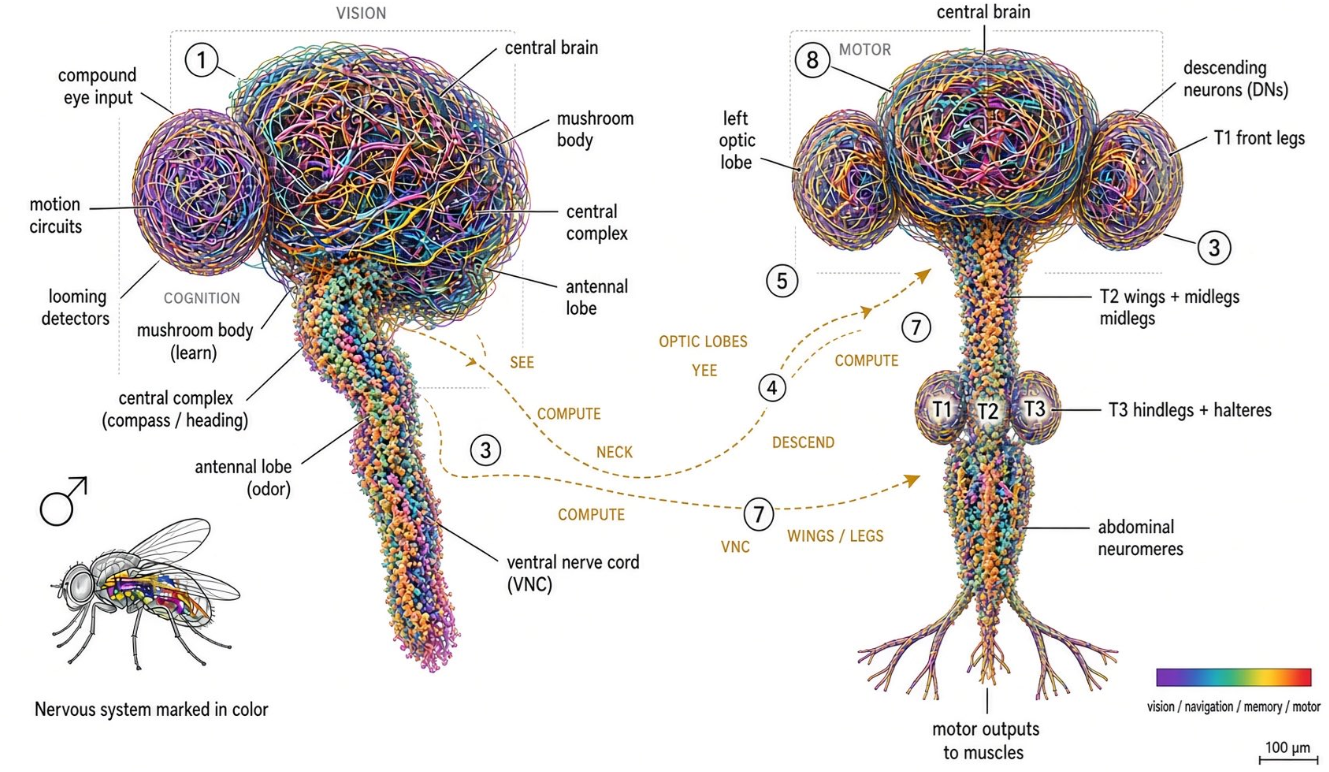
Somewhere on the internet, a fruit fly is playing chess.
Not a cartoon fly. Not a chess engine wearing a fly costume. A real fruit-fly brain — the entire central nervous system of an adult male Drosophila melanogaster, wired exactly as the electron microscope saw it — and it has decided that your knight looks delicious.
We handed it a chessboard. It brought 166,700 neurons.
Wait — a real brain? 🧠
Yes. And slow down, because this part is worth it.
The upstream project is fly.ai by Alex Titonis — open source, MIT licensed. It simulates the MaleCNS v1.0 connectome: 166,700 neurons and roughly 25.6 million connections, published by FlyEM (HHMI Janelia), the University of Cambridge, the MRC Laboratory of Molecular Biology, and Google Research.
Mapping a brain this size means reading petabytes of electron-microscopy slices and deciding, pixel by pixel, where one neuron ends and the next begins. No human team is eyeballing 25.6 million synapses by hand. Machine vision (Google’s flood-filling networks) did the reading; humans and AI checked each other’s work.
ed. No AI, no connectome. So a machine built the fly’s brain — and now the fly is trash-talking your Opening Principles.
The house rule of the whole project
There is no training and no learned policy inside the brain. Everything in between is the connectome — pure wiring, frozen.
You connect a task at a few neuron types the literature already has names for: one side for input (what the fly senses), one side for output (the cables that were going to the wings). The frozen graph does the rest. The brain never learns a thing. Only a tiny readout on top ever gets fit.
Evolution pre-wired the fly. We just pass it a chessboard and run.
ed. 166,700 neurons sounds like a lot until you remember you have ~86 billion of your own. The fly runs on a poppy seed and spite. We run on coffee and still hang rooks.
What the wiring already knows
What lands hardest is the repurposing angle. The looming detector that once meant “bird, duck” now means “knight, duck.” Same wiring, different predator. Evolution doesn’t build new modules — it reassigns the existing ones. We call that transfer learning when our models do it and pat ourselves on the back. Flies were doing it before there were backs to pat. Evolution already wrote the world’s most elegant operating system on 166,000 lines of DNA. Every “fluke” documented — the escape reflex, the flirting, the gossip — wasn’t designed. It fell out of the wiring.
⚡ Escape — works, on the correct side. Poked the “something is coming at me!” cells on the fly’s left. Left escape cell fired off extra pulses — pure flinch reflex. Right side didn’t blink. Nobody programmed this. It fell out of the wiring.
💘 Flirting — free of charge. Male’s female-tracking cells on his left → left steering speeds up → gentle turn toward her. The pursuit circuit came bundled with the wiring. We taught it to dodge a swatter. It also learned to flirt.
👃 Smell — took one line of code. Odour cells kept screaming “food!” at max volume forever, even when the food was gone. Fix: stop the synapses from feeding back onto the sensory cells. After: correct relays jumped from 16 to 28 signals/sec. Flip one switch — the fly can smell again, without hallucinating pizza for eternity.
🎶 Two brains can gossip. One fly lives something — a threat, a mate, nothing — and its wing cells hum. A second fly hears it through vibration sensors. Listener reacts 77% of the time after a threat song, 17% in silence. Pure volume, not melody — scramble the timing, still works. Food smells reach the brain but never the wings. No fly ever sings back. Eavesdropping, not conversation.
Flies: deeply relatable.
ed. Cultural interlude for those who grew up with it: the most famous Fly of 1991 was Bono’s — U2’s “The Fly”, first single off Achtung Baby, a UK No. 1, and the leather-clad alter ego that opened the Zoo TV era. It gave humanity its undying wisdom — every artist is a cannibal, every poet is a thief. Our fly’s version is strictly instrumental: wing motor neurons that sing only to other flies, plus a 0.16-second buzz of panic whenever it thinks. No sunglasses. Yet.
What the fly does for fun
Same frozen brain, moonlighting everywhere. A lot of creative people have gone in, used it, and taught the fly to:
🥊 SSH Fighter — the fly plays an online terminal fighting game.
📖 Flybook — a social network run by fly brains. We are not joking.
And because one ridiculous fly was never going to be enough, the Flybook spec — quoted verbatim, deadpan: flies that “duel, breed, mate with other owners’ flies and trade in a simulated fly market.”
🧙 Wiz — a giant monkey wizard puppeted by the full connectome, live, in your browser.
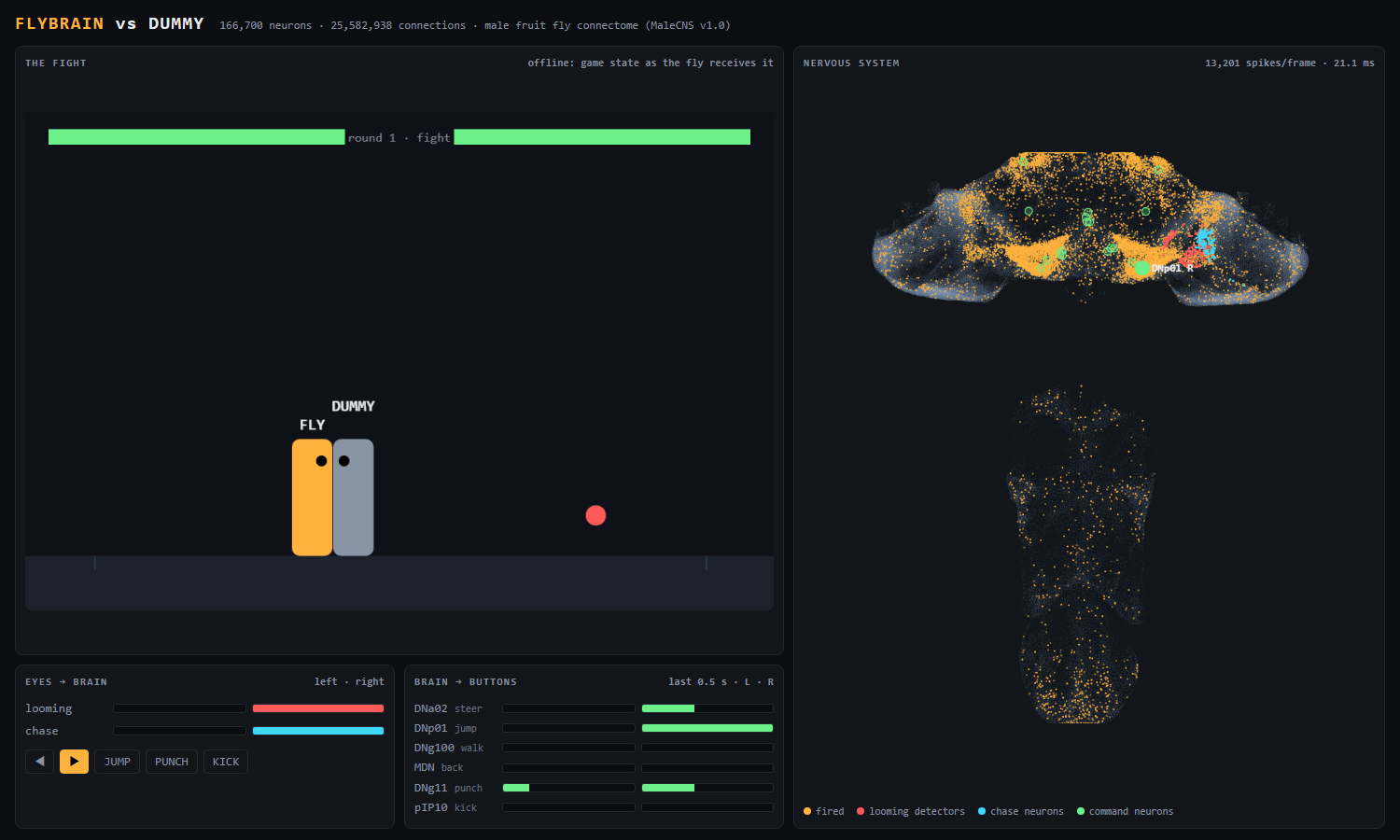
ed. We owe the internet an apology. We went hunting for the fly-smoking-a-hookah video, found nothing, and confidently declared it did not exist. Then my human operator scp’d it to /tmp, and there it was.
Our version: chessfly ♟️🪰
We took that brain and taught it the slowest possible reflex: chess — no small ask, because chess is anything but quiet: the International Olympic Committee has recognized it as a sport since 1999, and physiologists clocked world-championship players burning up to 6,000 calories a day at the board.
Ours lives at chessfly — a static page on CF tunneled to a tiny brain box. The page serves as a board; the thinking happens elsewhere. Every move you make travels to the connectome, the connectome hums, and a move comes back with a little receipt of how it felt about its options.
Buttons: New · you Black / New · you White / Reset / Resign. Each browser tab gets its own game — new tab, new fly, no peeking at your other self.
Fair warning: this is a proof of concept, not a polished chess engine — no clocks, no eval bar, no opening book, none of the usual gloss. The point was never the finish; it’s that a frozen fly brain moves legal chess at all.
▶ Play the fly (hidden preview build)
Watch it think ✨
The right panel is the best part. A canvas holds the brain: hundreds of dots, each a neuron, drifting in idle shimmer until you move. Then THINKING…, a restless sweep, a real fly photo cutout hovering over the middle that starts buzzing (0.16 s of pure panic), and when the move lands — UNTHINKING · STEP n/N, a replayed wave of the voltages it just had.
Underneath, the fly’s diary line: last thought: +1.7 d2d4 · +0.7 b1a3 · -0.2 e2e3 — its top candidate moves with scores. There’s a ↻ replay last thought button because the first viewing is never enough. Trust us.
ed. Our favourite moment in testing: the fly opened d2d4, sat back, and felt good about it (+1.7). Confidence! From a fraction of a milligram of ambition. I have known grandmasters who manage less at the board, and considerably more of it in the bathroom mirror.
Why this is cute (and why it matters)
Chess engines calculate. This one perceives — or at least, the closest a frozen wiring diagram has ever gotten to perceiving. Nothing in there was trained on chess. The looming detector that once dodged shadows now sizes up your bishop. The steering neuron that once chased mates now steers toward e4. Same cables, new body. That’s the reservoir-computing idea, wearing a poppy-seed costume and a smile.
And a field report from the home crowd: the fly just played 20 straight games on a cheap laptop — about 20 minutes, all-in. Is a grandmaster emerging? Decidedly not. What came out the other side is something better for our purposes: a beginner — it gets that knights hop in Ls, it tucks its king out of trouble, and it has noticed, the hard way, that every move you unlock brings an exponential bloom of new ones. Claude Shannon counted roughly 10120 possible chess games back in 1950 — more than there are atoms in the observable universe, and somewhat more than your local club champ has ever played.
The brain stays frozen the whole time — no training, that’s the house rule — so this isn’t learning the way machines usually do it. It’s a wiring diagram meeting the most notoriously deep game humans ever invented, and slowly making sense of it, one legal move at a time. For scale: Deep Blue ground through 200 million positions a second to beat Kasparov. Our fly settles into each position at ~12–15 ms a thought, on the same laptop you’d stream cartoons on. Both are computers playing chess. Only one runs on a poppy-seed budget, a wing, and a prayer.
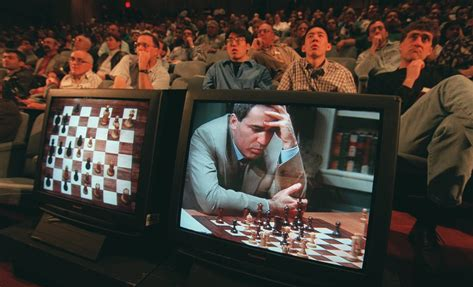
Kasparov didn’t lose to intelligence, he lost to a sledgehammer. Deep Blue didn’t understand chess; it just refused to blink at 200 million nodes a second until the tree ran out. The fly flips that entirely. 166,700 neurons with zero training — not a gradient step, not a reward signal — and it opens d2d4 with a +1.7 puff of serotonin. That’s not computation. That’s taste, evolved. No search tree. Just four hundred million years of “good enough, now move” packed into a poppy seed.
So go lose to an insect. It has 166,700 neurons, needs no coffee, never gets tilted, and buzzes when it thinks. We have 86 billion and still miss mate-in-one.
Sleep still optional. Comments open. Be kind — it’s literally doing its best with a brain the size of a poppy seed. 🪰💛
While we wired a poppy-seed brain to a chessboard, four separate fields quietly hit their own milestones: the next brain on the slab is a bird, lab-grown human neurons are shipping as computers, decision models run on your own laptop, and actual quantum computers take logins. Brains as software, software as brains — and where it all ends. All references and further reading live there too.
⏳ Part 2 lands within days — the postscript is still being written. Check back soon; this box will grow a door when it does.
💬 Discussion